
Book Publication: Machine-Readable Faces : Pixels, Proxies, Praxes
Voto, Cristina. 2027. Machine-Readable Faces : Pixels, Proxies, Praxes. London: Routledge.
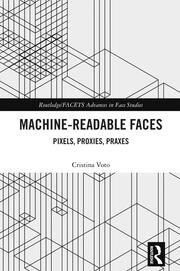
Machine-Readable Faces: Pixels, Proxies, Praxes investigates how facial images have been operationalised, reshaping the conditions under which identity becomes intelligible and computable. Moving across visual semiotics, digital humanities, and computational studies, the book traces the emergence of facial data—from early digitisation experiments to dataset-driven practices—and shows how the face has been reconfigured as a proxy within technical infrastructures.
Along this trajectory, facial archives, large-scale image datasets, and training processes within computational infrastructures are analysed at the intersection of visual culture and computational modelling. The book develops a theoretical framework centred on three operative praxes—modelling, archiving, and tagging—through which facial images function as both metalinguistic operators and infrastructural agents of recognition. This framework offers a critical rearticulation of the epistemological and cultural implications of data-driven identity.
Grounded in an interdisciplinary exchange, the book will interest scholars and graduate students working on machine vision, digital culture, and the philosophy of technology, as well as those engaged in visual culture, media sociology, and feminist and gender studies.
Cristina Voto is an Assistant Professor in the Department of Human Studies at the University of Turin (Italy). She is a member of the doctoral board of the Diseño y Creación program at Universidad de Caldas (Colombia) and of the Artes y Tecno-Estéticas program at Universidad Nacional de Tres de Febrero (Argentina), and currently serves as Vice President of the Latin American Federation of Semiotics – FELS. Her research lies at the intersection of visual semiotics, the philosophy of technology, gender studies and digital arts. She has published extensively on these topics, including articles, edited volumes (Rostrotopías. Mitos, narrativas y obsesiones de las plataformas digitales, Aracne, 2023; I cronotopi del volto, Aracne, 2022; Rostrosferas de América Latina. Culturas, traducciones y mestizajes, Aracne, 2021), and the monographs Monstruos audiovisuales. Agentividad, movimiento y morfología (Aracne, 2021) and Machine-Readable Faces Pixels, Proxies, Praxes (Routledge, 2026).